


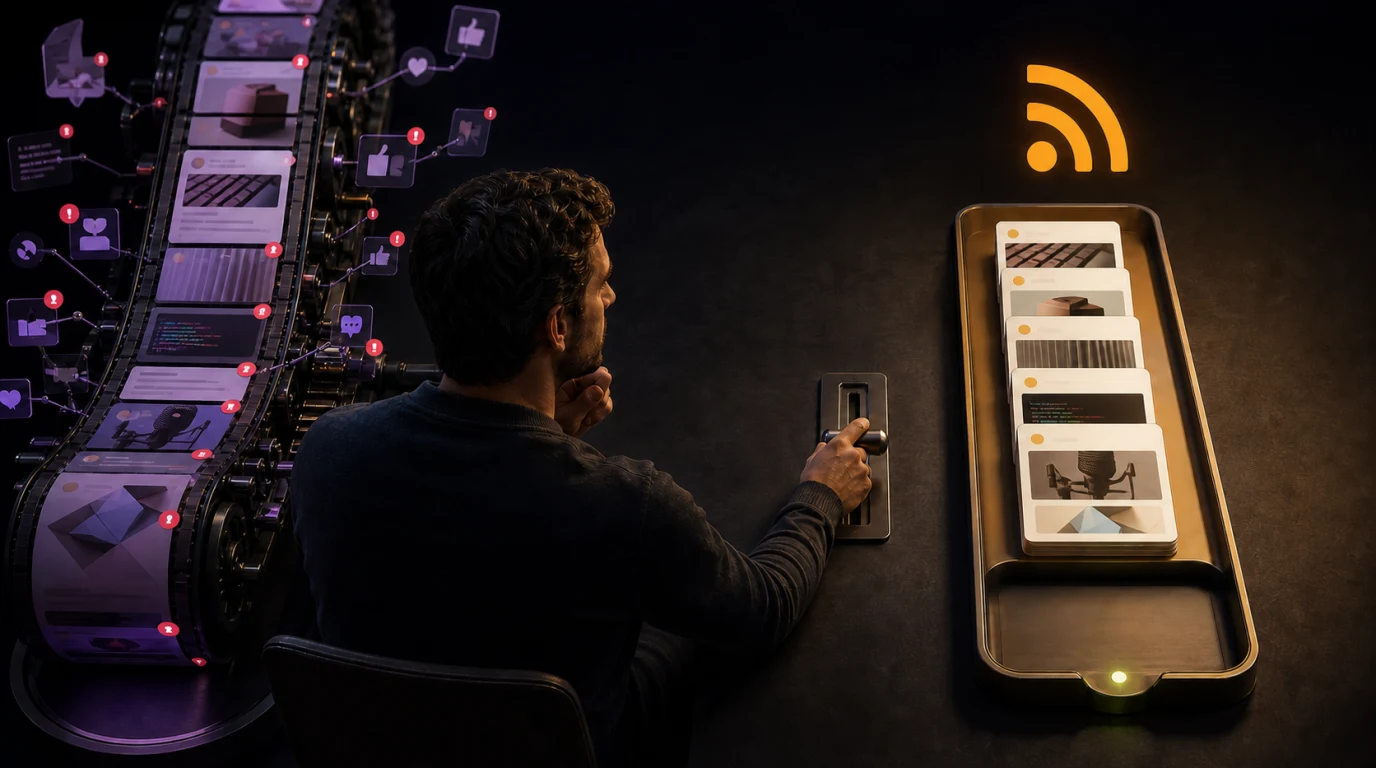
If you want to read the web without an algorithmic feed, the answer is RSS. You subscribe to the sites you actually care about, and a reader collects new posts in order, with no ranking, no ads injected between items, and no infinite scroll. You decide what you follow, you see everything those sources publish, and when you reach the end, you are done.
That last part is the quiet revolution. Algorithmic feeds are built to never end. RSS is built to finish. The difference changes how reading the web feels.
Why your feeds feel broken
The feeds on most large platforms are not broken by accident. They work exactly as designed. The design goal is just not the same as yours.
- They optimize for engagement, not usefulness. The ranking aims to keep you scrolling, which favors outrage, novelty, and whatever held attention yesterday.
- They hide what you asked for. You follow a source, then the algorithm decides you only see a slice of its posts, mixed with things you never chose.
- They have no end. Infinite scroll removes the natural stopping point, so a quick check becomes twenty minutes.
- They reward reaction over reflection. Short, loud content rises. Long, careful pieces sink.
The result is a feed that feels busy but rarely satisfying. You see a lot and remember little. You miss the posts you actually wanted because they were not the posts that drove the most taps.
The problem is not that you lack discipline. The feed is a slot machine, and it is winning on purpose.
What RSS does differently
RSS, which stands for Really Simple Syndication, is an old, boring, and very good technology. A site publishes a feed. You subscribe in a reader. The reader checks for new items and shows them to you in plain chronological order.
There is no engagement model underneath it. Nobody is paid when you scroll. Because of that, RSS gives you a few things algorithmic feeds cannot.
- Completeness. You see every post from every source you follow, not a ranked sample.
- Chronology. Newest items appear in order, so you always know where you left off.
- A finite session. When you have read the new items, the feed is empty. You stop.
- No surveillance baked in. A good reader does not need to track you to function.
- Portability. Your subscription list lives in an OPML file you can export and move anywhere.
It is the same web, the same writers, the same news. The only thing that changes is who controls the order. With RSS, that is you.
Algorithmic feed versus RSS
| What you experience | Algorithmic feed | RSS reader |
|---|---|---|
| Who picks the order | The platform | You |
| Do you see every post | No, a ranked sample | Yes, all of them |
| Does it ever end | No, infinite scroll | Yes, when you finish |
| Ads injected into the stream | Often | No |
| Tracking required to work | Usually | No |
| Can you take your list with you | Rarely | Yes, via OPML |
How to start in a few steps
Switching is faster than people expect. You do not need to quit anything cold turkey. Run RSS alongside your current habits for a week and see how it feels.
1. Pick a reader
Choose an app that collects your feeds in one place. Look for one that is privacy-respecting, lets you organize sources into folders, and supports OPML import and export so you are never locked in.
2. Add the sources you actually read
Start with ten to twenty. Think of the blogs, news sites, newsletters, and creators you would be annoyed to miss. Most sites still publish a feed, often at a /feed or /rss address. Many readers can find it for you from the site URL.
3. Organize into folders
Group sources by topic, like news, work, and hobbies. This lets you read in focused sessions instead of one big pile, which is what made the old feed exhausting.
4. Add filters as you go
Once feeds are flowing, keyword filters help you mute noise or highlight the topics you care about most. This is curation you control, not a black box guessing for you.
5. Build a calm habit
Check it once or twice a day. Because the feed ends, you can finish and walk away. That is the whole point. Reading becomes a task you complete rather than a stream you fall into.
What about sites with no feed
The honest gap in classic RSS is that some sites never published a feed. That used to mean you simply could not follow them this way.
Modern readers are closing that gap. SparkFeed, the reader we build, follows any site even when it has no RSS feed, by building a feed for you. It keeps the calm, chronological, you-are-in-control experience of RSS, adds folders, keyword filters, and OPML import and export, and stays privacy-first with zero telemetry. It is open source and still in early access, so it is new rather than battle-tested. There is also an optional Spark AI summary that runs on your own AI key, so you can skim what is new without handing your reading history to anyone.
The point is not the specific tool. The point is that the old clunky reader experience is no longer the trade-off. You can have the control of RSS and a modern, pleasant app at the same time.
The takeaway
Your feeds feel broken because they were tuned to keep you scrolling, not to keep you informed. RSS flips that. You choose the sources, you see everything they publish, and the session ends when you are done. Start with one reader and ten feeds this week, and notice how much calmer reading the web becomes.
If you want a modern way to do this, including following sites that never had a feed, you can try SparkFeed in early access.
