



To find article ideas from sources you follow, look for a change that raises a useful question for your reader. Capture a specific observation, turn it into a reader question, choose an angle that adds judgment or utility, verify the claim, and pitch the resulting assignment.
This workflow suits freelance writers and in-house writers who cover a recurring industry beat. It keeps the source trail attached to the idea, which makes a pitch easier to trust and a finished article easier to update. The process is simple enough for one writer, but it also gives an editor a clear record of why a topic belongs on the calendar.
What is the best way to find article ideas from sources?
The best way is to move through six linked decisions: source, observation, reader question, distinct angle, verification, and pitch. Do not treat a headline as an assignment. Treat it as a signal that still needs a useful question and a defensible point of view.
Start with a beat and a source set. A beat might be independent retail, creative businesses, workplace culture, or sustainable packaging. Your source set can include official blogs, release notes, research repositories, public datasets, company filings, trade associations, and credible practitioners. The RSS 2.0 specification and Atom standard, RFC 4287, describe common ways publishers expose dated items, but a useful source can also be a public page without a feed.
Record the source and its publication date before you interpret it. This small habit prevents a familiar topic from drifting into an unsupported claim and lets you return to the original context later.
How do you turn a source into an article idea?
Turn a source into an article idea by writing down what changed, what remains unanswered, and who needs the answer. A headline is a starting point. An article idea has a reader, a question, a promise, and evidence.
1. Capture the observation
An observation records what the source says before you add your interpretation. For example, Etsy published its Spring and Summer 2026 Seller Trend Report on March 17, 2026. It combines Etsy search data with industry forecasting. That is a description of a dated source. It is not evidence that every independent shop should change what it sells.
We use that report below as a worked example of the research method, not as current shopping advice. Before pitching a seasonal story now, check newer evidence and the season relevant to your readers.
Include the source URL, publisher, date, relevant section, and a short excerpt in your note. You do not need to copy the whole source. You need enough context to find the claim again.
2. Ask the reader question
The reader question explains why the observation matters to a person who is not the publisher. Ask what the source leaves the reader needing to decide, do, compare, or understand.
Useful questions include:
- What would a small shop owner need to check before acting on this?
- How should a manager revise a process around it?
- Which part applies to a small team, and which part applies only to an enterprise?
- What is the difference between the announcement and the practical effect?
- What should a reader check before adopting the recommendation?
Avoid a question that simply repeats the source title. “What are the latest trends?” is a summary assignment. “How can a handmade seller evaluate a trend without abandoning the shop’s identity?” points toward a useful reported guide.
3. Choose a distinct angle
A distinct angle tells the reader what your article will do that the source does not. It can explain a workflow, compare choices, translate technical language, test a claim, document a decision, or show a narrow audience how to act.
The angle should be specific enough to shape reporting. “Retail trends” is broad. “How independent makers decide which trends to ignore” names a reader and a decision. It also gives you a reason to interview makers instead of rewriting a marketplace’s report.
These are proposed reporting angles inspired by the existence and scope of the Etsy report. They are not conclusions established by it:
| Reader question | Proposed article | Evidence still needed |
|---|---|---|
| How do I judge whether a trend fits my existing products? | A maker’s checklist for evaluating a seasonal trend | Interviews with makers, examples of their selection process, and evidence of what they chose to keep unchanged |
| How should I present a handmade product clearly online? | What a product photograph should help a customer understand | Interviews with photographers and buyers, plus permission to analyze real listing examples |
| How do I tell a temporary burst of attention from a durable customer need? | Questions to ask before writing a trend-led product story | Newer source material, the scope of each dataset, and firsthand accounts from sellers |
Each angle creates work. That is useful. If you cannot name the evidence required, the idea is still a headline, not a pitch.
How should writers verify an idea before pitching it?
Verify the central observation against the primary source, then test the practical implication with a second authoritative source or an identified expert. Verification is where an interesting signal becomes a responsible assignment.
The source should support only the fact you attribute to it. Etsy’s report can establish what Etsy published for that season. It does not establish your client’s sales, the whole retail market, or whether a proposed change works. Those require other evidence.
For a trend-led story, check the underlying dates and geography. If you consult Google Trends, read Google’s explanation of Trends data: the values are normalized relative interest, not absolute search counts or sales. Two datasets can provide context without measuring the same thing.
Do not use a secondary summary to make a stronger claim than the primary source makes. If a publisher says a change is available, that does not prove every reader has adopted it. If a company says a feature improves a workflow, that does not prove a numerical result for your audience. Keep the wording at the level the evidence can carry.
Ask these questions during verification:
- What exactly is confirmed, and on what date?
- Is the source describing a launch, a plan, a test, or a recommendation?
- Which readers are affected?
- What evidence would disprove or narrow the angle?
- Does the source use a term that needs a definition?
If the answer is not available yet, write “to verify” in the idea record. A transparent gap is more useful than a polished assumption.
What is a good article pitch from a source?
A good pitch names the reader, the question, the evidence, the proposed structure, and the practical payoff. It gives an editor enough information to judge the assignment without asking the editor to reverse-engineer your thought process.
Use this compact format:
Working title: How independent makers decide which trends to ignore
Reader: Handmade-business owners who already have a recognizable product range
Starting source: Etsy’s March 17, 2026 seasonal report, with a check for newer evidence before pitching
Question: What makes a trend worth exploring for an established shop?
Angle: Report how several makers evaluate a trend against their own customers, materials, and production constraints.
Reporting plan: Interview makers with different approaches, ask for specific examples, check the dates of any supporting data, and distinguish a seller’s experience from a general recommendation.
Boundary: The article will describe decisions and tradeoffs. It will not claim that following a trend guarantees sales.
That boundary makes the pitch stronger because it shows where the evidence stops. If the piece needs interviews, say who should be interviewed and why. If the source is enough for a short explainer, say that too.
How should writers organize sources, article ideas, and editorial notes?
Keep source organization, article shortlists, and editorial decisions as three related records. They answer different questions and become confusing when combined.
Use source folders for the publications, feeds, public pages, or topics you follow. Use favorites for individual articles that deserve a closer read or may become a lead. Keep the editorial ledger in a separate document with the observation, reader question, angle, status, evidence, pitch date, editor response, and next review date.
| Record | What belongs there | What it should answer |
|---|---|---|
| Source folder | RSS or Atom sources, public listing pages, and beat groupings | What do I follow? |
| Favorite article | A specific item worth reviewing again | Which item may become a lead? |
| Editorial ledger | Question, angle, verification, pitch, status, and decision | What am I doing with this lead? |
This separation prevents a folder from becoming an unsearchable archive of half-formed ideas. It also makes handoffs clearer when an editor or collaborator needs to review the work.
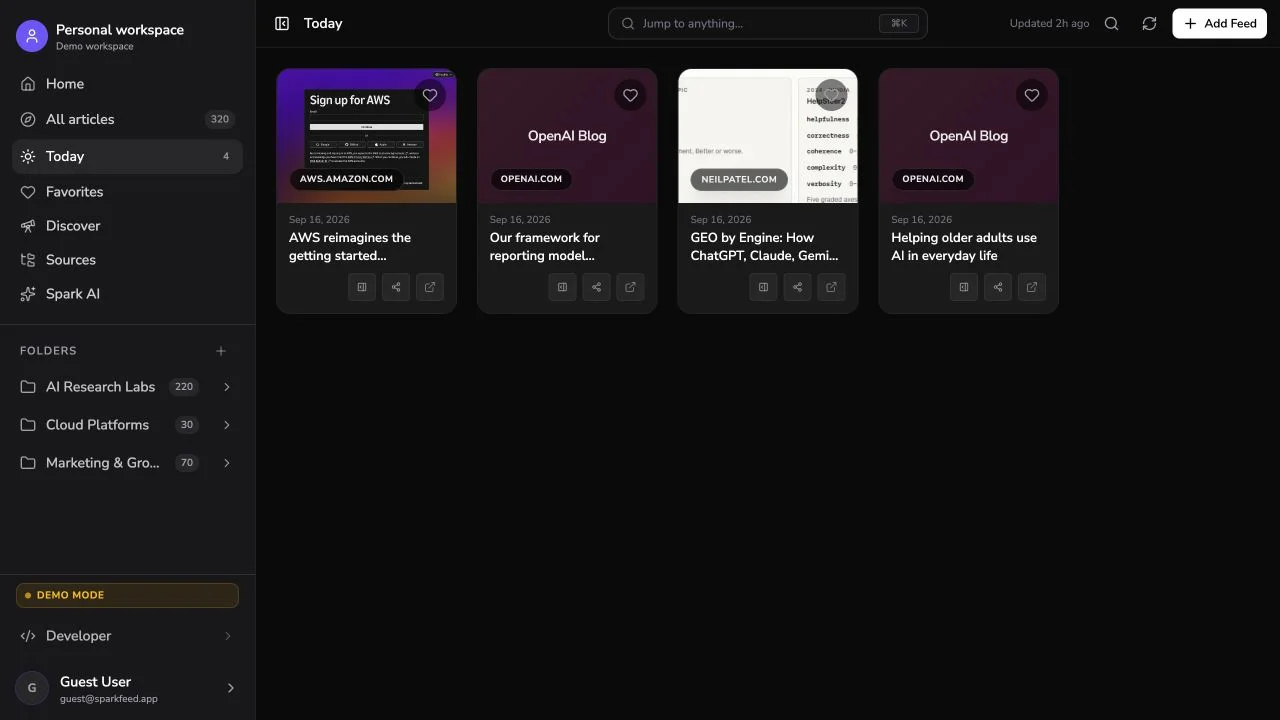
Sparkfeed can support the collection layer by bringing RSS and Atom sources and supported public pages without feeds into one workspace. You can group sources in folders and shortlist individual articles in Favorites. Its source reader and feed workflow is useful when a beat spans public newsletter archives, company news, blogs, and public listing pages. Keep the editorial ledger in the document or system your publication already uses.
Are keyword tools better than following sources for article ideas?
Keyword tools and source monitoring answer different questions. A keyword tool can reveal how people phrase a query and help you estimate the shape of demand. Sources show what changed, what experts are publishing, and which questions are emerging in your beat.
Use a keyword tool after you have a credible editorial signal, or use it to test wording for an angle you already understand. Do not let a keyword phrase manufacture expertise. A high-interest query can still produce a thin article if you have no new evidence, useful process, or clear audience.
Google’s SEO Starter Guide emphasizes useful, well-organized content for readers. That is a better editorial test than chasing a phrase in isolation. Ask whether the proposed article helps the reader do something, understand a change, or make a decision.
| Use source monitoring when you need to find | Use keyword research when you need to test |
|---|---|
| A real change in your industry | The wording readers may use |
| First-party evidence and dates | Possible subtopics and terminology |
| A timely question for a recurring beat | Whether a title is discoverable |
| Signals that may become a reported piece | Variations for headings and internal links |
The strongest process combines the two late in the workflow. Let the source create the substance. Let keyword research help the reader find the finished answer.
How can Sparkfeed help with source-led ideation?
Sparkfeed can help a writer maintain a focused source set, review new items, and preserve candidate articles for later research. Add a feed or supported public page, organize sources by beat, and use Favorites for individual articles that have passed your first relevance check. Spark AI is optional and can help with review or querying, but writers should verify claims against the original source before pitching or publishing.
The newsletter curation workflow explains how a source set can feed a repeatable editorial review. The Feedly alternatives comparison covers a different concern, privacy and control over reading data. Whichever tool you use, the editorial decision still belongs in your ledger, alongside the source URL and observation date.
For client assignments, add a public-source research map to the brief. You can explore the demo or start a free research workspace with one beat and a few sources. You do not need AI or a paid plan to start reading and saving useful articles.
Sources and further reading
- Etsy: Seller Trend Report, Spring and Summer 2026, March 17, 2026
- Google Trends: Understanding the data
- Google Search Central: SEO Starter Guide
- RSS Advisory Board: RSS 2.0 Specification
- RFC Editor: The Atom Syndication Format, RFC 4287
- Sparkfeed, hosted research workspace
Frequently Asked Questions
How do I find article ideas when my industry feels repetitive?
Return to a defined source set and look for changes, unanswered questions, and consequences for a specific reader. A repeated topic can still support a new article when the audience, evidence, or practical decision changes. Keep a record of published angles so you can see which questions remain open.
What sources are best for finding blog topics?
First-party release notes, official research, public datasets, regulatory pages, trade associations, and specialist publications are strong starting points. Choose sources close to the decision your reader needs to make. A source is useful because it can support a claim, not because it produces a large volume of headlines.
How many sources should a writer follow?
Follow enough sources to cover the beat from several perspectives, then remove sources that repeat one another or rarely produce usable evidence. The right number depends on the beat and your review time. A small, well-labeled set is easier to understand than a giant unread list.
Should every article idea come from a current news item?
No. A current item can trigger an idea, but evergreen questions, recurring workflows, and unresolved reader problems are just as valuable. Use the source as evidence or context when it genuinely helps the article answer the question.
How do I know whether an article idea is distinctive?
State what your article will add that the source does not: a decision guide, an implementation routine, a comparison, a tested explanation, or reporting from affected users. If the only difference is a rewritten headline, the angle is not ready.
Can AI turn sources into article ideas?
AI can help cluster items, surface repeated terms, and suggest questions for human review. It can also miss context or overstate a source, so keep the original link and verify the central claim yourself. Use AI to widen the set of questions, then use editorial judgment to select and report the idea.
