



Competitive intelligence is gathered by starting with a business decision, choosing public sources that can inform it, collecting those sources on a schedule, and separating observed facts from analysis. A useful program does not try to watch the whole internet. It watches a small, explicit source set and records why each signal matters.
This guide shows the complete workflow. It covers ethical boundaries, source selection, RSS and website monitoring, tagging, deduplication, analysis, confidence, and reporting. It also includes a dated source-map example that a team can copy.
What is competitive intelligence?
Competitive intelligence is the ethical collection and analysis of information about a market, company, product, or customer environment. It helps a team make a specific decision. It is not corporate espionage, impersonation, unauthorized access, or a folder full of interesting links.
The distinction matters. The Strategic Consortium of Intelligence Professionals says practitioners should comply with applicable laws, disclose their identity before interviews, avoid conflicts of interest, and provide honest conclusions. A sensible internal rule is stricter than “the page was public.” Respect access controls, terms, privacy, intellectual property, and the laws that apply to your organization.
Competitive intelligence should make decisions easier to explain. If the collection method would be embarrassing to disclose, do not use it.
What are the five steps for gathering competitive intelligence?
The five steps are to define the decision, map the sources, collect consistently, analyze with evidence, and distribute the result to the people who can act on it.
1. Define the decision before collecting anything
A narrow question produces better intelligence than a broad request to “keep an eye on competitors.” Name the decision, deadline, and owner.
Good questions look like these:
- Did a competitor change its enterprise packaging this quarter?
- Which customer segment is the company hiring to support?
- Has its public API strategy shifted toward agents or automation?
- Which product claims appeared across its homepage, documentation, and release notes?
Write down what would count as evidence before the feed starts filling up. This keeps a logo change or a new blog post from becoming a strategy claim without support.
2. Build a source map
A source map lists each place you will watch, the signal it can provide, the collection method, and its limitations.
| Source | What it can show | Collection method | Main limitation |
|---|---|---|---|
| Product and pricing pages | Packaging, messaging, target segment | Website-change feed or page monitor | A wording change may be a test, not a strategy shift |
| Documentation and changelogs | Shipped capabilities and technical direction | RSS, Atom, or watched page | Documentation can lag the product |
| Careers pages | Roles, locations, and skill investment | Watched listing page | An open role does not prove a product plan |
| Company blog and newsroom | Launches, partnerships, and positioning | Native RSS or Atom feed | The company controls the narrative |
| Regulatory filings | Risks, material events, and financial context | Filing alerts and official databases | Relevant mainly to regulated or public companies |
| Reviews and communities | Repeated customer complaints and language | Permitted public pages and exports | Identity, sample bias, and authenticity vary |
| Internal field notes | Buyer objections and deal context | CRM or approved team submission | Requires consent, access controls, and careful attribution |
Start with first-party sources. A product page is stronger evidence of current messaging than a three-year-old roundup. A regulator’s database is stronger evidence of a filing than a social post describing it.
3. Collect sources consistently
Use RSS or Atom where the publisher provides it. Use a page monitor for sources without a feed. The RSS 2.0 specification defines a stable syndication format, while Atom is standardized as RFC 4287. Both give a collector titles, links, dates, and item identifiers in a predictable shape.
No-RSS pages need a different collector. Pricing, careers, integration directories, and documentation indexes often fall into this group. A dedicated page-diff tool is useful when exact text or visual changes matter. An any-site-to-feed tool is useful when the team wants those updates in the same reading workflow as news and release feeds.
For a broader comparison of collection products, see 10 market intelligence tools for B2B teams. If the job is limited to page changes, the guide to website change detection without a SaaS bill covers self-hosted and hosted choices.
Teams starting with one rival can use the narrower competitor website monitoring setup before expanding into a full program.
4. Normalize, tag, and deduplicate
Collection is not analysis. Before a signal reaches a decision-maker, give it a consistent record.
At minimum, store:
- Source URL and publisher
- Observation date
- Page or item title
- Exact excerpt or captured change
- Topic and competitor tags
- Collection method
- Analyst note
- Confidence level
Deduplication matters because one announcement can appear on a newsroom page, in a feed, on a partner blog, and in several news stories. Keep the original first-party item as the main record. Attach secondary reporting when it adds context rather than counting each copy as a separate signal.
5. Analyze and distribute with confidence labels
Every report should distinguish facts from interpretation. A simple three-level system works:
| Confidence | Meaning | Example wording |
|---|---|---|
| High | Multiple direct sources agree | “The public pricing page and documentation now list the same new tier.” |
| Medium | One direct source supports a plausible interpretation | “The careers page suggests investment in enterprise security, based on three open roles.” |
| Low | Indirect or incomplete evidence | “A community comment may indicate dissatisfaction, but the identity and sample are unverified.” |
Do not hide uncertainty. A useful brief lets the reader see the source, observation, interpretation, confidence, and next action.
Which public sources should a team monitor?
The best sources are the ones closest to the decision. Most teams need fewer than they expect.
For product and go-to-market work, start with:
- Homepage and primary product pages
- Pricing and packaging
- Documentation and API references
- Changelog or release notes
- Careers and job listings
- Newsroom, blog, and partner announcements
- Review pages relevant to the category
- Official filings or public procurement records where applicable
The SEC EDGAR search is one example of an official source for public-company filings in the United States. Government databases differ by country and industry, so the source map should record jurisdiction and access terms.
Social posts can provide early clues, but they are weak evidence on their own. Treat them as leads to verify against a product page, filing, customer statement, or other direct source.
A dated public-source example
This example was assembled on August 31, 2026. It maps public OpenAI sources for an AI infrastructure team. It does not claim that OpenAI is a Sparkfeed customer, and it does not draw conclusions about the company. The point is to show a reproducible source map.
| Research need | Public source | Observation | Interpretation status |
|---|---|---|---|
| Product and model changes | Platform changelog | A dated sequence of documented changes | Observation only |
| API packaging | API pricing | Current public prices and billing units | Observation only |
| Company announcements | OpenAI News | First-party announcements and statements | Observation only |
| Hiring direction | OpenAI Careers | Public role titles, teams, and locations | A role can suggest investment, but does not prove a roadmap |
| Technical implementation | Developer documentation | Current public interfaces and guides | Documentation can change and should be captured with a date |
The collection setup is straightforward. Subscribe to any native feeds, watch the changelog, pricing, careers, and documentation pages, then store every new item with its source and observation date. The analyst can review a weekly folder without manually reopening five tabs.
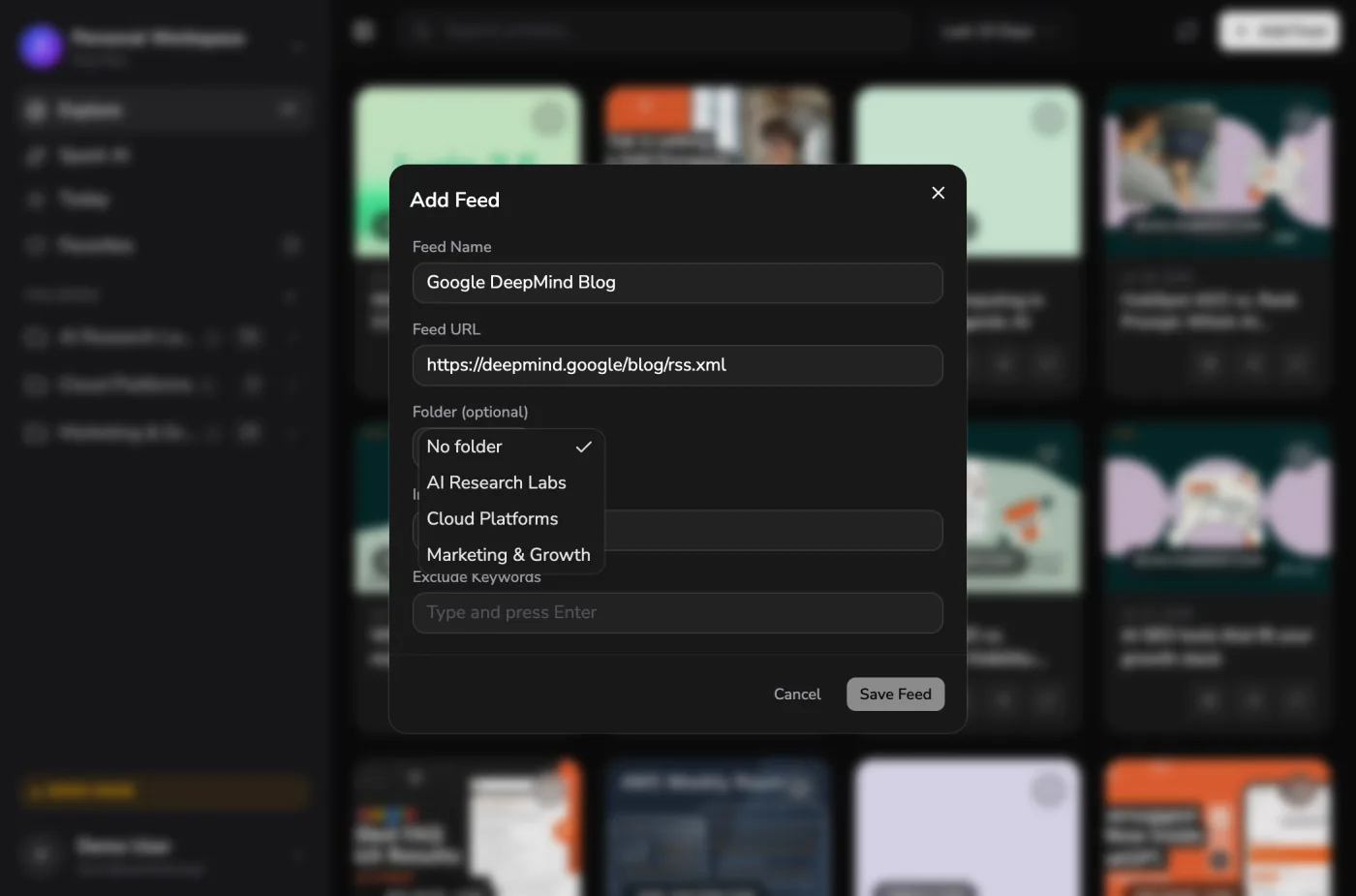
For exact page diffs, pair this feed with a change-detection tool. For a broader reading and research workflow, organize the sources by company and topic, then use search and summaries to review the period.
How can a writer research a client’s competitors?
A writer needs a source map that leads to useful questions, not a collection of copied competitor headlines. Start with the client’s audience and the decision the article or newsletter should help that audience make.
The following is an illustrative setup for a freelance writer covering small-business software. It is a research template, not a customer story or a claim about a particular company.
| Source group | What the writer looks for | Where the evidence goes | What it cannot prove |
|---|---|---|---|
| Client newsroom and release notes | What the client publicly says it shipped | A dated source link in the assignment brief | Whether customers use it successfully |
| Competitor blogs and help centers | Questions being answered and product limitations | A separate competitor source folder and a short comparison note | Competitor traffic, conversion, or market share |
| Independent trade publications | Context and questions beyond vendor announcements | A reading shortlist with links to originals | That every quoted claim is independently verified |
| Client interview | Experience, opinions, examples, and language | Interview notes in the client’s approved document system | That a public claim is accurate without checking it |
Use source folders to group recurring publications. Use favorites to shortlist individual articles. Keep the writing brief in a separate document with fields for the source URL, publication date, observation, interpretation, and open question. A folder is an organizational tool, not a substitute for client permissions or a secure document repository.
For example, a rival publishing several help articles about onboarding could give you an interview question: “Where do new customers get stuck during setup?” It does not prove that the rival has an onboarding problem. Ask the client for firsthand evidence and check what the public pages actually say before turning a pattern into a claim.
Ghostwriters can use the same public-source routine before a founder interview. Bring the announcement and a question about its implications. The client’s experience and voice still have to come from the client. Do not present a feed summary as something the founder personally observed.
To develop the writing angle, follow the process for finding article ideas from sources you already follow. If the output is a weekly roundup, use the newsletter curation workflow to select, verify, and explain each link. Neither process replaces interviews or original reporting.
How Sparkfeed supports public-source research
Sparkfeed brings RSS and Atom feeds, source discovery, and supported no-RSS public pages into a reading workspace. Folders organize the source list, Favorites shortlist articles, and Sources helps you inspect collection health. An empty or quiet source needs checking before you interpret it as a company doing nothing.
For a solo writer, hosted Free provides a personal workspace. Personal+ adds higher no-RSS allowances and API and MCP access. Hosted Pro is for shared team workspaces. Team access should follow the client’s confidentiality requirements; simply placing two clients in different folders does not isolate access.
The complete Community Edition is available under AGPL-3.0-only. A self-hoster supplies infrastructure and optional AI-provider configuration. Sparkable’s hosted service manages those operations and provides plan-based AI credits. The self-hosting documentation explains the operator’s setup responsibilities.
Spark AI can assist with reviewing source material, but a summary is not independent evidence. Read the original before citing it, check dates and qualifications, and keep analysis separate from a vendor’s claims. The privacy policy explains provider data handling. Scheduled email digests and webhook delivery are not part of this workflow.
Sparkfeed does not replace interviews, proprietary analyst research, social-listening databases, or a dedicated page-diff tool. Start by testing representative sources in a free research workspace, or explore the demo to inspect the reading interface. For a broader product comparison, see market intelligence tools for different research jobs.
How should a competitive-intelligence report be structured?
A short report should answer one question and preserve the evidence behind the answer.
A practical one-page format is:
- Decision or question
- Three to five material observations
- Source link and observation date for each item
- Interpretation and confidence
- What remains unknown
- Recommended action
- Owner and review date
Archive the source records even after distributing the brief. A later decision may depend on what was public at that time, not what the page says today.
Sources and further reading
- SCIP: Gaining Market Insight from Events and its ethics guidance
- RSS Advisory Board: RSS 2.0 Specification
- RFC Editor: The Atom Syndication Format, RFC 4287
- SEC: Search EDGAR filings
- Sparkfeed documentation
- Sparkfeed source code
Frequently Asked Questions
What are good sources of competitive intelligence?
Good sources are direct, dated, and relevant to the decision. Product pages, pricing, documentation, changelogs, careers pages, official filings, and first-party announcements usually form the core. Reviews and social posts are useful leads, but they need verification.
How do you collect competitive intelligence?
Define a question, map the public sources that can answer it, collect them on a schedule, and store each observation with its source and date. Then analyze the evidence with an explicit confidence level before sharing it.
Is competitive intelligence legal?
Ethical competitive intelligence relies on lawfully obtained information and honest collection methods. Do not bypass access controls, misrepresent your identity, solicit confidential information, or ignore applicable terms and laws. Organizations should have counsel review collection policies for their industry and jurisdiction.
What is the difference between competitive intelligence and competitive analysis?
Competitive intelligence is the ongoing collection and interpretation of market signals. Competitive analysis is usually a specific evaluation produced from that evidence, such as a positioning comparison or pricing review.
How often should competitive intelligence be updated?
The source set can collect continuously, but review frequency should match the decision. Pricing and security notices may need immediate alerts. Blog, hiring, and partnership signals often fit a daily or weekly review.
Can AI gather competitive intelligence?
AI can summarize, classify, search, and compare collected material. It should not decide which unverified sources are trustworthy or turn one weak signal into a confident business claim. Keep source links, confidence labels, and human review in the workflow.
